Cumulative Bitcoin Coin Days Destroyed#
What It Measures#
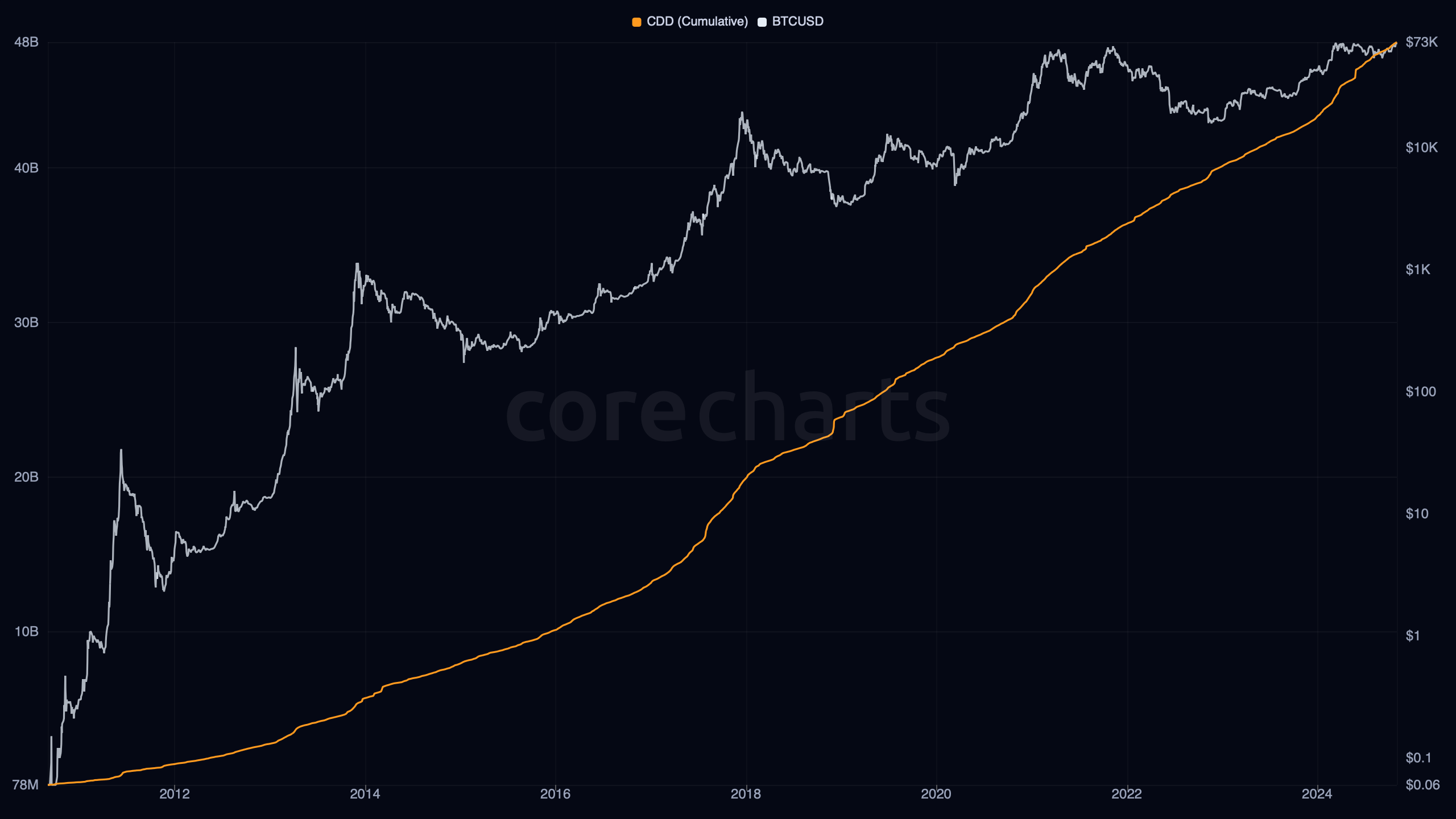
Cumulative Bitcoin Coin Days Destroyed is the running total of all coin-days destroyed across Bitcoin’s history.
It answers a structural question:
How much dormant coin-age has the network spent away in total over time?
The logic is simple:
This series does not reset. It grows as the network destroys more accumulated age through spending.
That makes it different from daily CDD. Daily CDD shows what happened on a specific day. Cumulative CDD shows the long-term stock of destroyed dormancy.
How To Use It#
On its own, Cumulative CDD is not usually a front-line chart for trading or cycle timing. Its main value is as a structural input to Liveliness.
That is because Liveliness compares:
- the total dormancy that has been destroyed,
- against the total dormancy the network could have accumulated.
So the practical use of Cumulative CDD is to provide the numerator in that long-run relationship.
It is most useful when the goal is to understand whether Bitcoin’s history has been characterized more by:
- preserving dormant supply,
- or spending it away.
What It Can Say About Market Regime#
By itself, Cumulative CDD is too monotonic to function as a clean regime signal. It rises through time as more dormancy is destroyed.
Its real interpretive value appears when compared with the network’s cumulative supply-age base.
That comparison becomes Liveliness.
So while daily CDD helps identify bursts of old-coin activity, Cumulative CDD helps answer the broader question of how much dormant age the network has already spent through its full history.
Historical Background#
Cumulative CDD follows naturally from Coin Days Destroyed itself. Once daily age-destruction became an established concept, the long-run cumulative series became the natural way to compare destroyed dormancy with accumulated possible dormancy. That long-run comparison is what later made Liveliness possible.