Bitcoin Short-Term Holder Supply (Soft 155D Split)#
Definition#
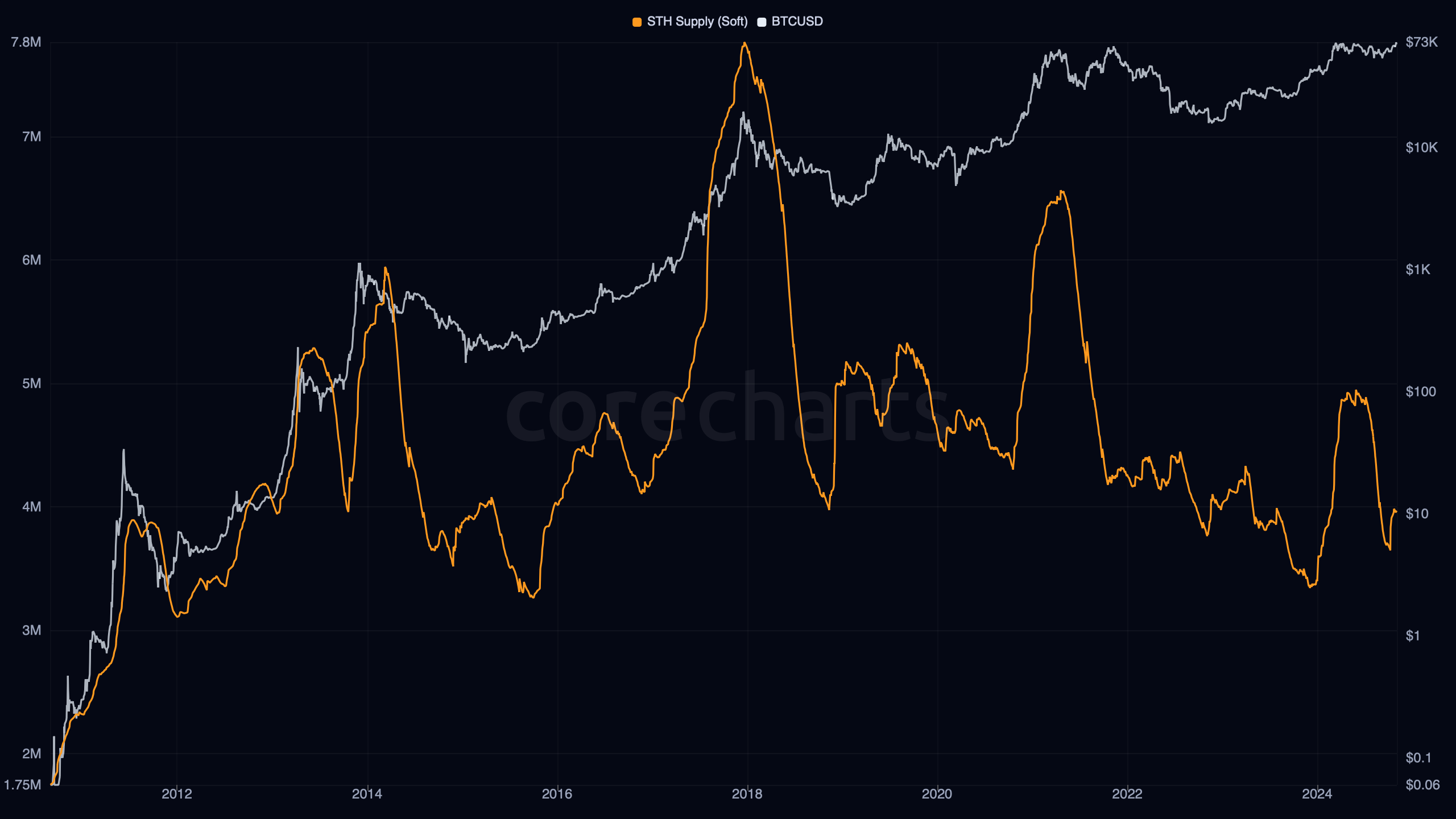
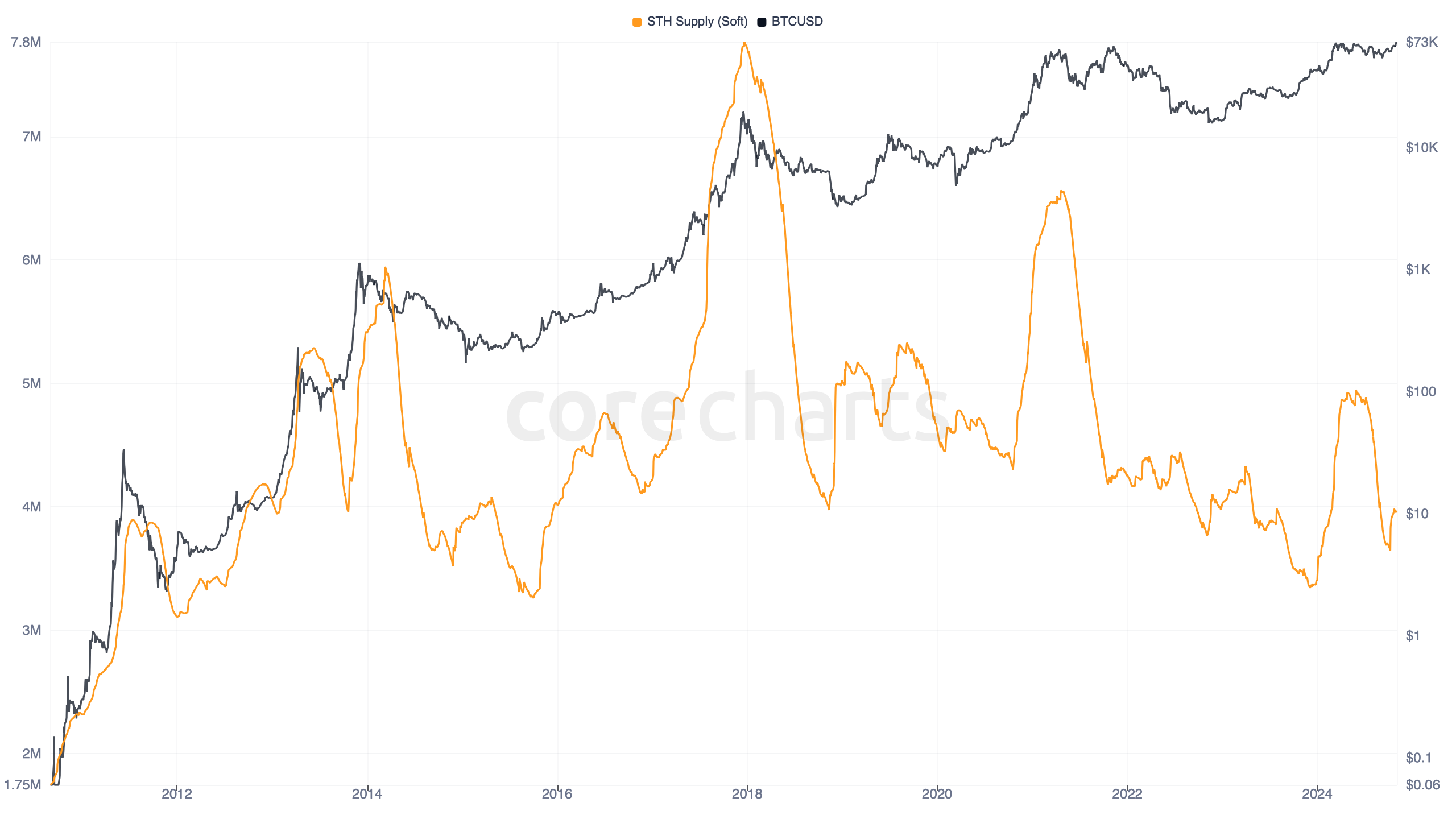
Bitcoin Short-Term Holder Supply measures the BTC inventory assigned to the recent-holder side of the STH/LTH age split.
Each coin receives a short-term holder weight based on its age. Coins well below the 155-day maturity area receive high STH weight; coins well above it receive little or no STH weight.
Values are denominated in BTC. The soft boundary reduces mechanical jumps around the 155-day cutoff by assigning partial cohort weights near the transition area.
Known holder identity is outside the measurement. Exchange reshuffling, custody movements, batching, and change outputs can reset coin age without proving a new economic buyer.
Interpretation#
Rising STH Supply means more BTC sits on the recent-holder side of the age distribution. Existing coins can enter the short-term cohort when they move on-chain and reset age.
Falling STH Supply means recent coins are aging out of the short-term cohort. The decline can occur without any reduction in circulating supply because the classification depends on coin age, not issuance.
A larger STH inventory points to heavier recent turnover. A smaller STH inventory points to lower recent movement and more supply approaching long-term holder status.
The direction of STH Supply separates recent movement from coin maturation. It does not state whether moved coins were spent in profit or loss.
Reading the Series#
During distribution-heavy regimes, older coins can move into newer hands and raise STH Supply. The increase comes from age reset inside the existing UTXO set, not from new BTC issuance.
During renewed demand phases, STH Supply can rise as buyers receive recently moved coins. In the same window, LTH Supply (Soft) can decline if mature coins are the source of that transfer.
During quieter accumulation phases, STH Supply can fall as recent coins continue aging toward the long-term holder cohort. This regime often produces a falling STH line even while price remains volatile.
Sharp STH Supply increases after long dormant periods mark a change in on-chain turnover. The series does not separate exchange inventory, custody structure, or derivative liquidity from the underlying coin-age reset.
Relationship to Other Metrics#
LTH Supply (Soft) measures the mature-holder inventory created by the same age-weighting model. STH Supply gains BTC weight when coins move recently; LTH Supply gains BTC weight when younger coins age into the mature side of the split.
LTH/STH Supply Ratio (Soft) removes the absolute BTC scale and reports the relative balance between mature and recent supply. The direct STH Supply line preserves the size of the recent-holder inventory in BTC.
STH Realized Price attaches a cost basis to the recent-holder cohort. STH Supply measures how much BTC belongs to that cohort, while STH Realized Price measures the average acquisition price carried by it.
Supply Last Active 1D-1W, Supply Last Active 1W-1M, and related age-band series provide narrower age slices. STH Supply aggregates the recent side of the holder split around the 155-day maturity area.
Supply in Profit and Supply in Loss classify coins by price relative to realized cost basis. STH Supply classifies coins by age since last on-chain movement.
Methodology Note#
The 155-day split comes from coin age, measured by time since last on-chain movement. The soft model treats the boundary as a transition zone around that age.
A hard boundary can move coins from full STH status to full LTH status in one daily step. The soft version assigns gradual weights near the threshold, reducing artifacts caused by coins crossing the cutoff.
Large custody transfers can raise STH Supply without a confirmed change in economic ownership. The age reset still enters the cohort accounting because the UTXO was spent on-chain.
The same transaction can represent a sale, self-custody movement, exchange maintenance, consolidation, or change output. STH Supply records the age reset, not the off-chain intent behind it.
Historical Background#
The short-term and long-term holder distinction became common in Bitcoin on-chain analysis through empirical work on UTXO age and spending probability. Younger coins tend to move more often than older coins, and the spending probability curve flattens after roughly five months.
The 155-day boundary became a practical cohort threshold for separating recently moved supply from mature supply. Later implementations introduced soft cohort weighting to reduce discontinuities around the cutoff.
STH Supply belongs to the cohort family that includes LTH Supply, STH Realized Price, LTH Realized Price, and the LTH/STH Supply Ratio.