Bitcoin Thermo Cap vs Market Cap#
Definition#
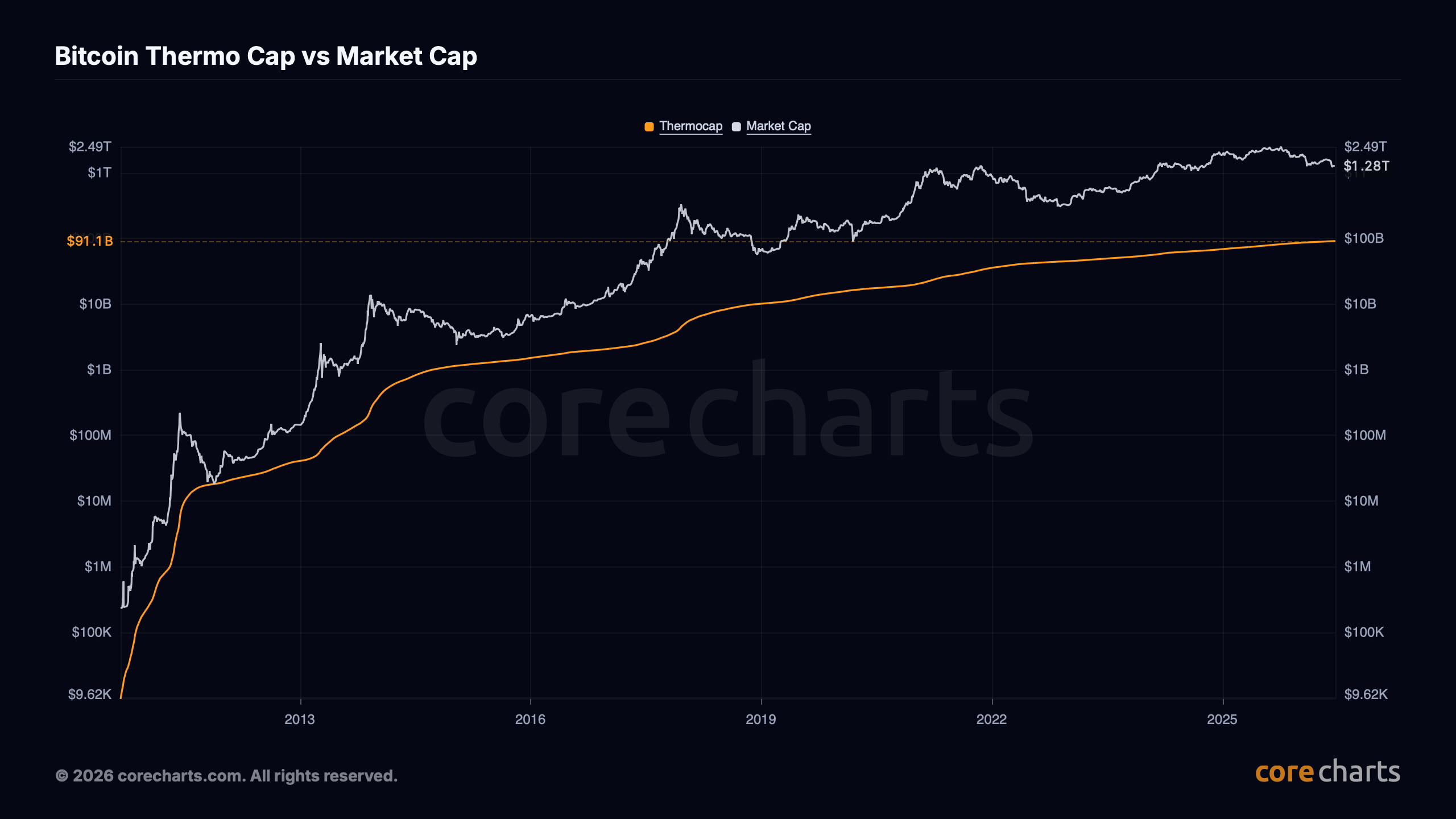
Bitcoin Thermo Cap vs Market Cap compares Bitcoin’s cumulative subsidy-value base with the current market value assigned to circulating supply.
Market Cap marks circulating supply at the current BTC price:
Thermo Cap accumulates the USD value of newly issued BTC at the time it entered circulation:
Both series are expressed in USD. Market Cap reprices the full circulating supply at spot. Thermo Cap changes only when new subsidy value is added.
The gap between the two lines measures the absolute USD distance between current market valuation and the cumulative subsidy-value base:
Positive spread means market valuation sits above cumulative subsidy value. Negative spread would mean market valuation has fallen below the historical subsidy-value base.
Interpretation#
Market Cap moves with BTC price across the full circulating supply. Thermo Cap moves through issuance: each day’s subsidy enters the cumulative base at that day’s BTC price.
A rising Market Cap with slower Thermo Cap means spot valuation is moving further above the subsidy-value base. A rising Thermo Cap with flatter Market Cap means new issuance value is still entering the cumulative base while spot valuation is not moving by the same amount.
Market Cap can fall sharply during drawdowns. Thermo Cap does not reverse, because historical subsidy value remains in the cumulative total after it has been added. The gap can narrow quickly when price falls, even though the subsidy-value base continues to rise.
A higher BTC price increases the USD value of new subsidy added to Thermo Cap. After halvings, fewer BTC enter through subsidy, so each added day contributes less native issuance than the prior subsidy epoch.
Reading the Series#
Large separation between Market Cap and Thermo Cap means current spot valuation stands far above the accumulated subsidy-value base. The absolute USD gap grows when Market Cap rises faster than new subsidy value accumulates.
Gap narrowing usually comes from falling Market Cap rather than falling Thermo Cap. Thermo Cap keeps accumulating, so sharp convergence means spot valuation has moved lower relative to the historical issuance-value base.
Post-halving periods change the rate at which Thermo Cap grows. The subsidy cut reduces the native BTC amount entering the cumulative base each block, while BTC price determines the USD value of that smaller flow.
Thermo Cap can rise faster during high-price issuance periods than during low-price issuance periods with the same block subsidy. The metric carries the price level at which each unit of subsidy entered the historical base.
Relationship to Other Metrics#
Thermo Cap Multiple turns the same Market Cap versus Thermo Cap relation into a ratio:
A reading of 10.0 means Market Cap is ten times the cumulative subsidy-value base.
Realized Cap vs Market Cap compares spot valuation with aggregate holder cost basis. Thermo Cap vs Market Cap compares spot valuation with cumulative subsidy value, so the denominator comes from issuance history rather than coin transfer history.
MVRV uses Realized Cap as its cost-basis denominator:
Puell Multiple works with current issuance value rather than cumulative issuance value. Thermo Cap accumulates subsidy value through time; Puell compares daily issuance value with its historical baseline.
Issuance in USD is the daily subsidy-value flow added to Thermo Cap. Miner Revenue in USD adds transaction fees to issuance value, while Thermo Cap isolates the subsidy-value base used in this comparison.
Methodology Note#
CoreCharts uses Thermo Cap as cumulative subsidy value. Transaction fees are not included in this version of the Thermo Cap base.
Some external implementations define thermocap as cumulative miner revenue, combining subsidy and transaction fees. CoreCharts separates those concepts: subsidy value enters Thermo Cap, while transaction fees belong to miner revenue and fee-market metrics.
Lost coins remain inside circulating supply for Market Cap unless supply is adjusted by a separate lost-coin model. Thermo Cap includes the subsidy value originally paid when those coins entered circulation, but it does not reprice them after issuance.
Thermo Cap is cumulative and does not fall after historical subsidy value has been added. Market Cap can move up or down immediately with BTC price.
The comparison is an absolute USD view. Thermo Cap Multiple provides the normalized ratio form of the same Market Cap versus Thermo Cap relationship.
Historical Background#
Thermocap entered Bitcoin on-chain analysis as aggregate security spend: the cumulative dollar value paid through mining over Bitcoin’s history. Public implementations differ on whether transaction fees are included with subsidy, but the shared concept is a historical mining-payout base priced at the time coins were mined.
Market Cap to Thermocap ratios became common after capitalization-based valuation metrics gained traction in Bitcoin analysis. The structure is similar to MVRV: current market value in the numerator, a slower historical base in the denominator.
CoreCharts applies the concept to cumulative subsidy value. This keeps the issuance-history base separate from transaction fees, which vary with block-space demand and are tracked through miner revenue and fee-share metrics.