Bitcoin Transaction Fees vs Miner Revenue#
Definition#
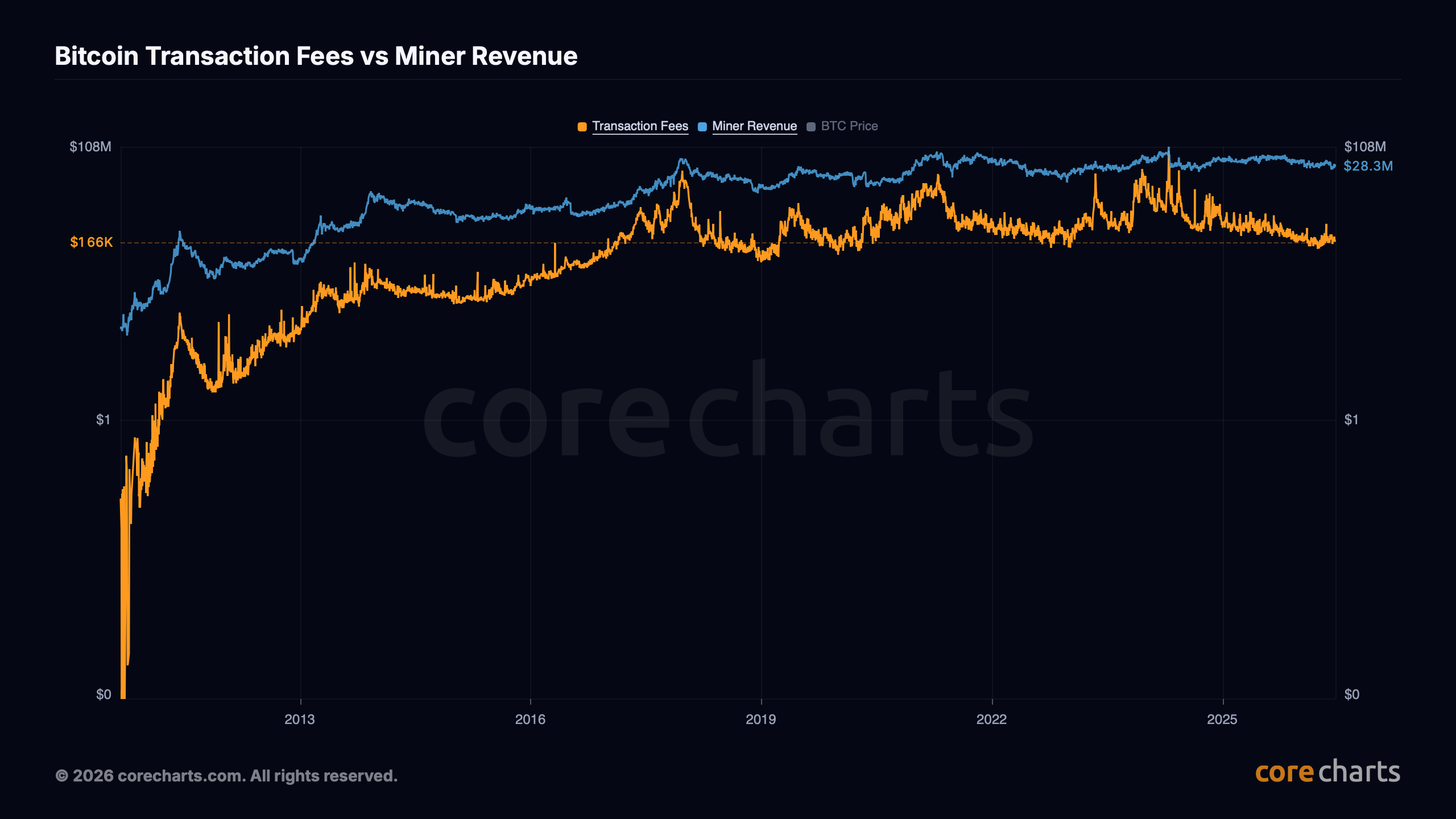
Bitcoin Transaction Fees vs Miner Revenue compares the fee-market component of miner income with the full miner payout stack.
Transaction fees are the total fees paid by users for confirmed transactions, converted into USD:
Miner revenue includes both block subsidy and transaction fees:
Both series are expressed in USD. Transaction Fees measures the user-funded part of miner income. Miner Revenue measures the full daily payout received by miners before operating costs.
The chart is an absolute USD comparison. Fee share is a separate ratio because it divides transaction fees by total miner revenue.
Interpretation#
Transaction Fees can rise in USD terms because users paid more fees in BTC, because BTC price rose, or both. Miner Revenue can rise even when fee pressure stays flat, since the subsidy component is also translated through BTC price.
A rising Transaction Fees line with a flatter Miner Revenue line means fee income is accounting for more of the miner payout stack. A rising Miner Revenue line with flat Transaction Fees means subsidy value or BTC price is carrying the move.
A falling Transaction Fees line means user-paid fee revenue has weakened in USD terms. That decline can come from lower fee rates, less fee-intensive block-space demand, lower BTC price, or a mix of those conditions.
Native fee metrics separate fee-market activity from price translation. Transaction Fees in sats records the fee pool before USD conversion, while Median Fee Rate prices block space per virtual byte.
Reading the Series#
Fee-heavy periods appear when Transaction Fees move closer to Miner Revenue. In those periods, a larger share of miner income comes from user-paid block-space demand rather than issuance.
Price-led miner revenue periods appear when Miner Revenue rises while Transaction Fees do not rise by the same degree. BTC price has increased the USD value of subsidy and fees, but the fee-market component has not taken a larger role in miner income.
Post-halving periods change the comparison by lowering the subsidy side of miner revenue. The same absolute fee amount can account for a larger share of revenue after a subsidy cut, even if fee demand itself has not changed.
Congested settlement periods can raise both total fees and fee rates. Total fees measure the aggregate amount paid by users, while fee rates separate price per vbyte from the number and size of transactions confirmed that day.
Relationship to Other Metrics#
Fee Share of Revenue normalizes transaction fees by total miner revenue:
A reading of 0.10 means transaction fees supplied 10% of miner revenue for the period measured.
Fees to Subsidy compares fee income with the issuance-funded part of miner payout:
Fee Share of Revenue uses the full payout stack as the denominator. Fees to Subsidy isolates the relation between user-paid fees and protocol issuance.
Transaction Fees in sats removes BTC price from the fee series. A rise in USD fees with flat native fees comes from price translation rather than a larger fee pool in BTC terms.
Miner Revenue combines subsidy and fees. Issuance in USD isolates the subsidy-value component before fees are added, while Hash Price scales miner revenue by estimated hash rate.
Methodology Note#
Transaction fees are measured from confirmed blocks. Fees attached to unconfirmed transactions do not enter the series until a transaction is mined.
Miner revenue is a gross revenue measure. It does not subtract electricity, hosting, hardware depreciation, pool fees, financing costs, or treasury activity.
USD conversion depends on BTC price. Native BTC and satoshi-denominated versions remain necessary when the fee market itself must be separated from fiat price movement.
Block subsidy follows the protocol schedule. Transaction fees vary with block-space demand, fee-rate bidding, transaction structure, and confirmation urgency.
Historical Background#
Bitcoin miners have always received two forms of block reward: the protocol subsidy and transaction fees. The subsidy creates new BTC according to the issuance schedule, while fees are paid by users competing for block space.
Early Bitcoin miner revenue was dominated by subsidy. Fee revenue became easier to measure as block-space demand increased and the subsidy declined through halving events.
The fee-versus-revenue comparison became more relevant after multiple subsidy cuts. By the fourth subsidy epoch, individual congestion events could make transaction fees a visible part of daily miner income in USD terms.