Bitcoin Long-Term Holder Realized Price (Soft 155D Split)#
Definition#
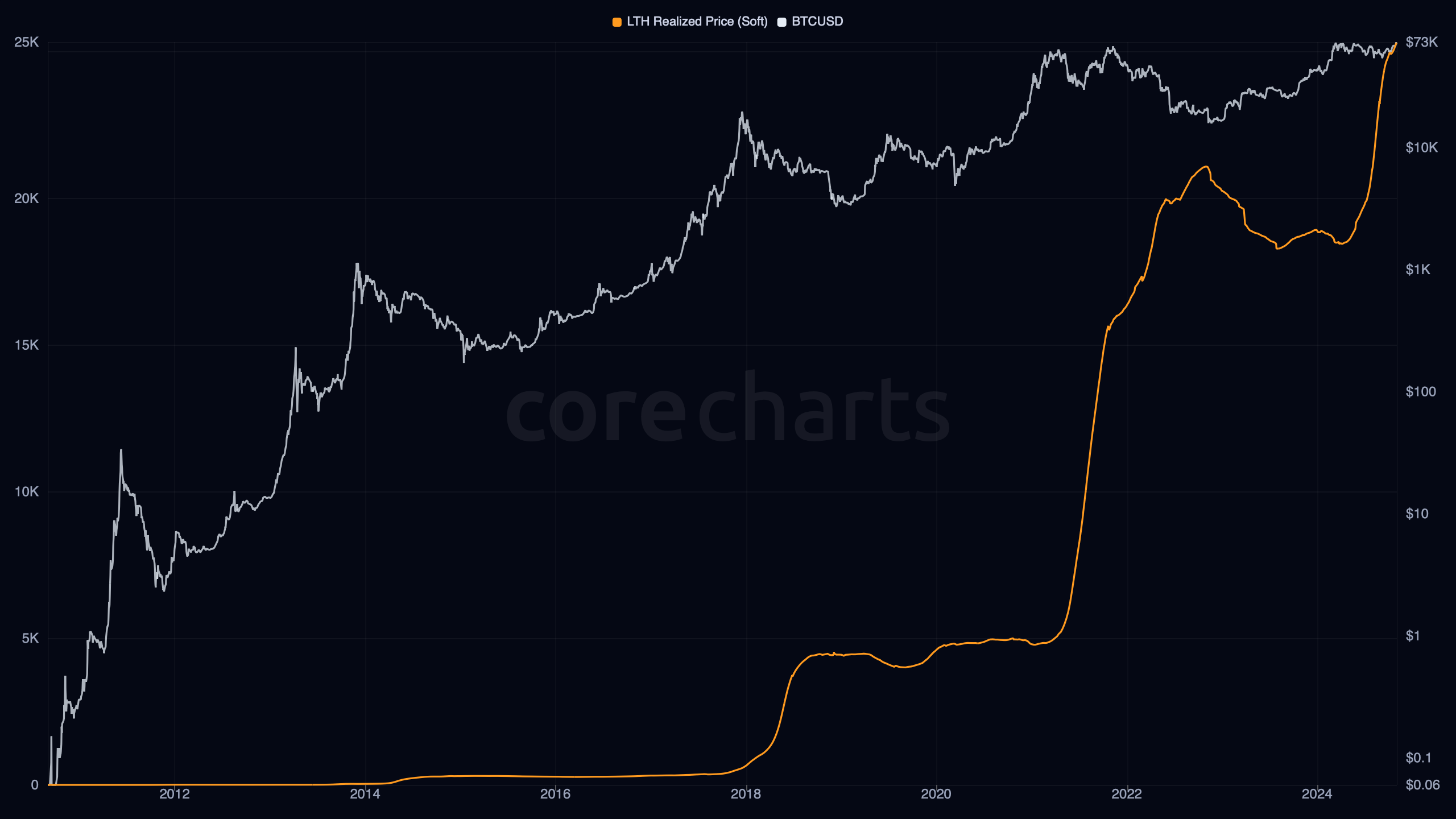
Bitcoin Long-Term Holder Realized Price estimates the weighted average USD cost basis assigned to mature-holder supply. CoreCharts uses a soft 155-day split, where each coin receives a gradual LTH weight as it moves beyond the short-term/long-term holder boundary.
The result is denominated in USD. A coin with full LTH weight contributes fully to the mature-holder cost basis, while a coin near the 155-day boundary contributes only partially.
Holder classification comes from coin age and last on-chain movement. Exchange reshuffling, custody movements, batching, and change outputs can reset coin age and realized price without proving a change in economic ownership.
Interpretation#
Rising LTH Realized Price means the weighted cost basis of mature supply is moving higher. This can happen when coins last moved at higher USD prices age into the long-term holder cohort, or when lower-basis mature coins leave the cohort after being spent.
Falling LTH Realized Price means mature supply is carrying a lower weighted cost basis. The decline can come from lower-price coins gaining LTH weight after the 155-day boundary, or from higher-basis mature coins being spent out of the cohort.
The line usually changes more slowly than STH Realized Price because mature-holder supply turns over less frequently. Large moves require either substantial coin maturation near the boundary or a material change in the composition of coins already assigned LTH weight.
BTC Price above LTH Realized Price places mature-holder supply above aggregate break-even. BTC Price below LTH Realized Price marks a rare regime where even the mature-holder cohort is underwater on average.
Reading the Series#
LTH Realized Price tends to rise after extended periods of higher market prices, once coins acquired or moved at those prices survive long enough to receive LTH weight. The lag is structural: the cohort only absorbs those cost bases as coin age crosses the maturity boundary.
During deep bear markets, LTH Realized Price can flatten or decline as lower-price coins mature into the cohort. If older high-basis coins are spent, their removal can also pull the weighted average lower.
The distance between BTC Price and LTH Realized Price marks the aggregate unrealized profit or loss of mature-holder supply. Because both series are USD price references, Sync mode keeps the mature-holder break-even line visually comparable against spot price across zoom ranges.
A sustained break below LTH Realized Price is historically associated with severe market stress. Brief intraday or short-window crosses carry less information than multi-day trading below the mature-holder cost basis.
Relationship to Other Metrics#
STH Realized Price estimates the weighted average cost basis of recent-holder supply. Comparing it with LTH Realized Price separates newer market entrants from older supply that has remained inactive long enough to cross the 155-day boundary.
LTH MVRV divides BTC Price by LTH Realized Price. The ratio converts the distance between spot price and mature-holder cost basis into a normalized profit/loss reading, while LTH Realized Price keeps the break-even level in USD.
Supply in Profit and Supply in Loss classify coins by whether market price is above or below their individual cost basis. LTH Realized Price gives one weighted average of those cost bases across the mature-holder cohort.
Realized Price uses the realized value of all circulating coins, regardless of holder age. LTH Realized Price isolates the cost basis of coins assigned long-term holder weight.
BTC Price is the market reference used to determine whether mature-holder cost basis is above or below spot. LTH Realized Price supplies the cohort-level break-even line; BTC Price supplies the current clearing price.
Methodology Note#
CoreCharts uses a soft transition around the 155-day STH/LTH boundary. Coins do not move from full STH weight to full LTH weight in one step.
For each coin, STH and LTH weights are complementary. BTC receiving more LTH weight receives less STH weight, preserving total supply across the two holder groups.
LTH Realized Price records the cost basis assigned after an on-chain spend, then applies long-term holder weight as the coin matures. Off-chain intent is not observable from the UTXO record alone.
Historical Background#
Long-Term Holder and Short-Term Holder realized price belong to the realized-cap family of Bitcoin on-chain metrics. The underlying realized price concept values coins at the price when they last moved on-chain, then converts that realized value into an average cost basis.
The 155-day boundary became common in on-chain analysis as a practical split between recently active supply and older supply. Hard-threshold versions classify each coin on one side of the boundary, while soft-threshold versions reduce discontinuities around the cutoff.
CoreCharts uses the soft 155-day split for LTH Realized Price to avoid abrupt cohort changes when large coin volumes age across the boundary on the same date.