Bitcoin STH Realized Price vs LTH Realized Price#
Definition#
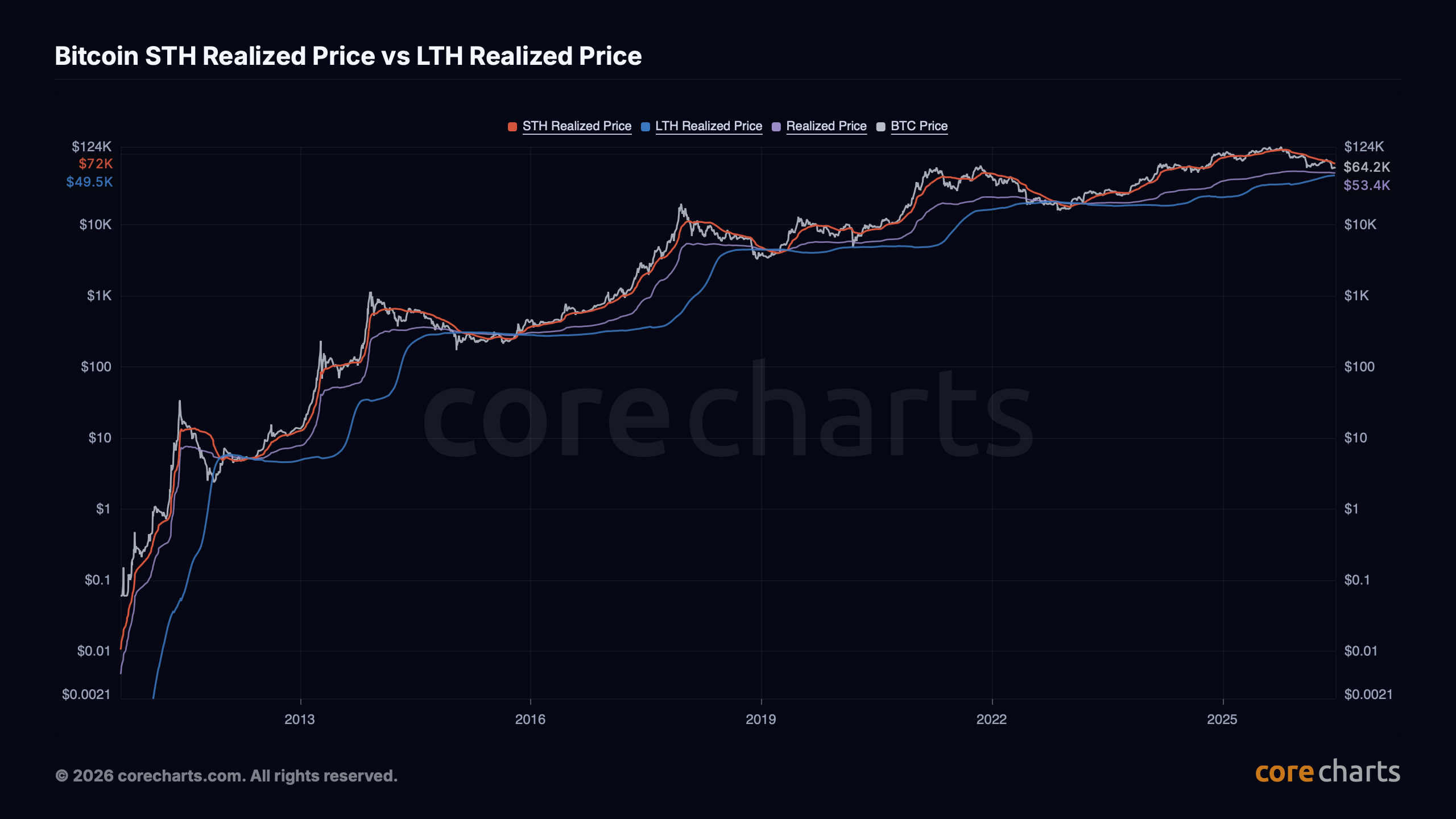
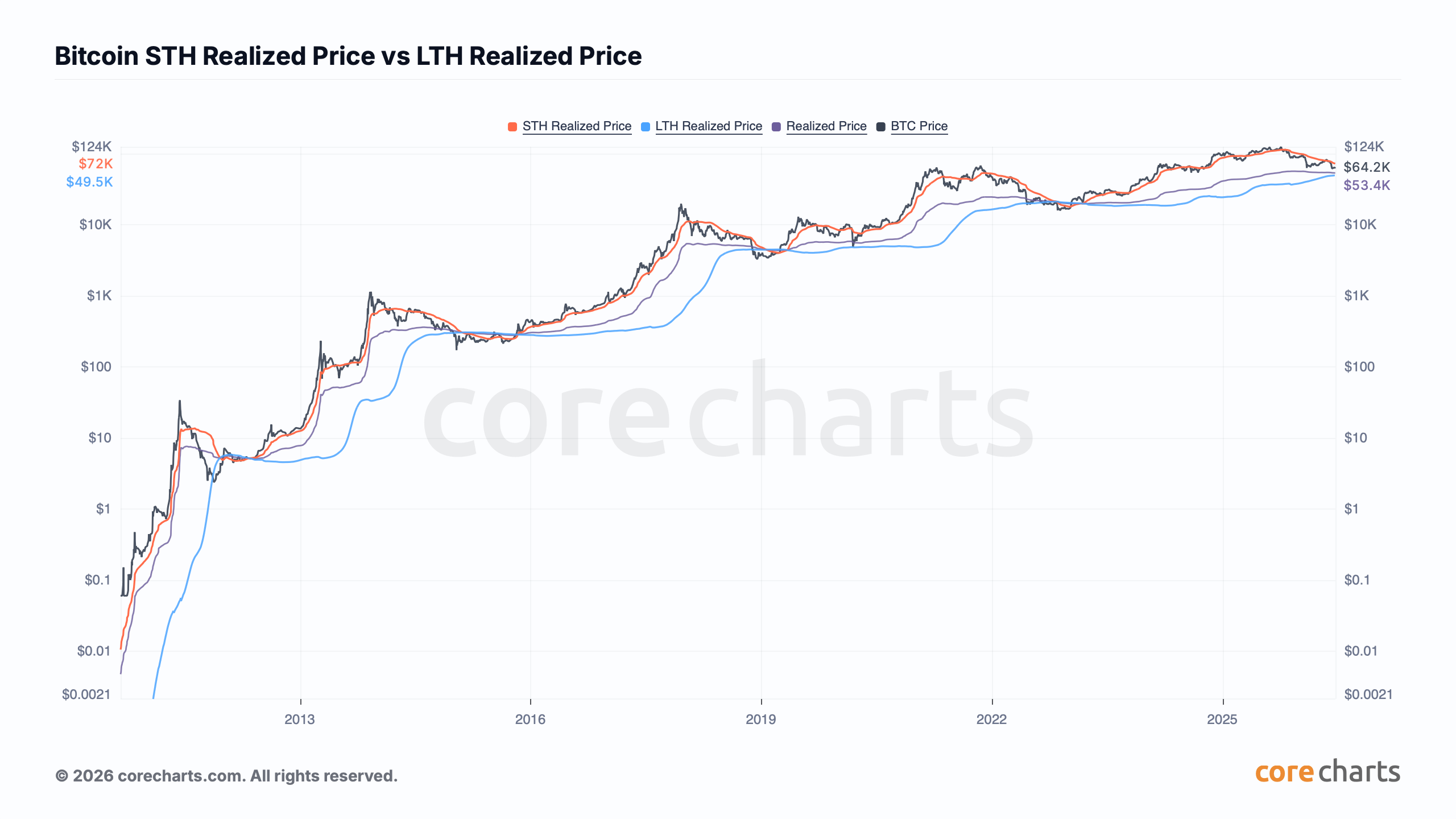
Bitcoin STH Realized Price vs LTH Realized Price compares cohort cost basis across recent and mature holder supply.
STH Realized Price is the realized price of short-term holder supply. In standard Bitcoin on-chain analysis, short-term holder supply refers to coins younger than roughly 155 days.
LTH Realized Price is the realized price of long-term holder supply. Long-term holder supply refers to coins older than the same maturity boundary.
Both series are expressed in USD. BTC Price gives the current market price, while aggregate Realized Price gives the market-wide cost basis across all circulating supply.
The chart separates three layers of cost basis: recent-holder cost basis, mature-holder cost basis, and aggregate network cost basis. The cohort lines update when coins move and reset their on-chain acquisition price.
Interpretation#
STH Realized Price moves fastest because recent-holder supply turns over more often. A rising STH Realized Price means newly held coins are carrying a higher average acquisition price. A falling STH Realized Price means short-term supply is being repriced lower through coins moving at lower prices than the prior recent-holder cost basis.
LTH Realized Price usually moves more slowly. Mature supply turns over less often, so large changes require older coins to move and reset their realized value. A rising LTH Realized Price means older low-cost coins have transferred into a higher realized-cost base. A falling LTH Realized Price means mature coins are being repriced lower, which usually requires older supply to move below its prior cost basis.
Crossings between the two cohort lines mark changes in cost-basis structure. When STH Realized Price sits above LTH Realized Price, recent-holder supply carries the higher average cost basis. When LTH Realized Price sits above STH Realized Price, the mature-holder base carries the higher cost basis, usually after a drawdown has repriced recent supply lower.
BTC Price adds the profit/loss state. Spot below STH Realized Price means aggregate recent-holder supply is underwater. Spot above LTH Realized Price means aggregate mature-holder supply carries unrealized profit.
Reading the Series#
During strong uptrends, BTC Price often trades above STH Realized Price and LTH Realized Price. Recent holders and mature holders both sit above their aggregate cost basis, while the STH line can rise quickly as new buyers enter at higher prices.
During sharp drawdowns, BTC Price can fall below STH Realized Price first. Recent-holder supply moves into aggregate unrealized loss before mature-holder supply does. A deeper drawdown can push spot toward aggregate Realized Price and, in severe regimes, toward LTH Realized Price.
A falling STH Realized Price during a drawdown means recent-holder cost basis is being reset lower. STH MVRV measures the unrealized pressure against spot, while STH SOPR shows whether recently held coins are actually being spent at a profit or loss. Realized Profit and Realized Loss add dollar scale to those spending outcomes, and spent-output age data shows whether the movement came from young supply or older coins re-entering circulation.
A rising LTH Realized Price after a long period of dormant supply growth means older coins have begun moving at higher prices than their prior realized values. This can raise the mature-holder cost basis even when the mature supply share remains high.
Relationship to Other Metrics#
Realized Price is the aggregate cost-basis line for the full coin supply. STH and LTH Realized Price split that aggregate line into cohort-specific cost bases.
STH MVRV converts the distance between BTC Price and STH Realized Price into a ratio:
LTH MVRV applies the same structure to mature supply:
A value above 1.0 means spot price is above the cohort realized price. A value below 1.0 means spot price is below the cohort realized price.
STH Supply and LTH Supply add inventory scale to the cost-basis lines. A cohort realized price can move sharply with a small transferring subset, while cohort supply shows whether the underlying inventory base is large or small.
STH SOPR and LTH SOPR measure realized spending outcomes for each cohort. Realized Price measures the cost basis held by the cohort; SOPR measures profit or loss at the moment coins are spent.
Methodology Note#
The STH/LTH boundary is based on coin age, not wallet identity. Coins are classified by time since last on-chain movement, so the metric describes supply age cohorts rather than known investor accounts.
A coin moving on-chain resets its age and realized price. Mature supply can become short-term supply after transfer, and the new cost basis enters the recent-holder realized-price calculation.
CoreCharts uses a soft STH/LTH cohort model for these series. The transition around the maturity boundary is smoothed rather than treated as a hard cliff, reducing artificial jumps when coins cross the 155-day area.
Exchange activity, custody reshuffling, internal wallet management, and other non-economic movements can reset coin age. Cohort realized price is a cost-basis estimate from on-chain movement, not a complete record of investor purchase price.
Historical Background#
The short-term and long-term holder distinction became common in Bitcoin on-chain analysis after empirical work on UTXO spending probability. Coins tend to become less likely to move as they age, with the decline in spending probability flattening around the five-month area. That area became a practical boundary between recently held and mature supply.
Short-term and long-term holder realized-price lines extend the Realized Cap concept into cohort-level cost basis. Instead of valuing the full coin supply at last movement price, the calculation separates recent and mature supply before deriving realized price.
Later implementations introduced soft cohort boundaries around the maturity threshold. A smoothed transition reduces mechanical jumps from a fixed day-count cutoff while preserving the short-term versus long-term holder structure.