Bitcoin Long-Term vs Short-Term Holder Supply Ratio (Soft 155D Split)#
Definition#
Bitcoin Long-Term vs Short-Term Holder Supply Ratio compares softly weighted long-term holder supply with softly weighted short-term holder supply.
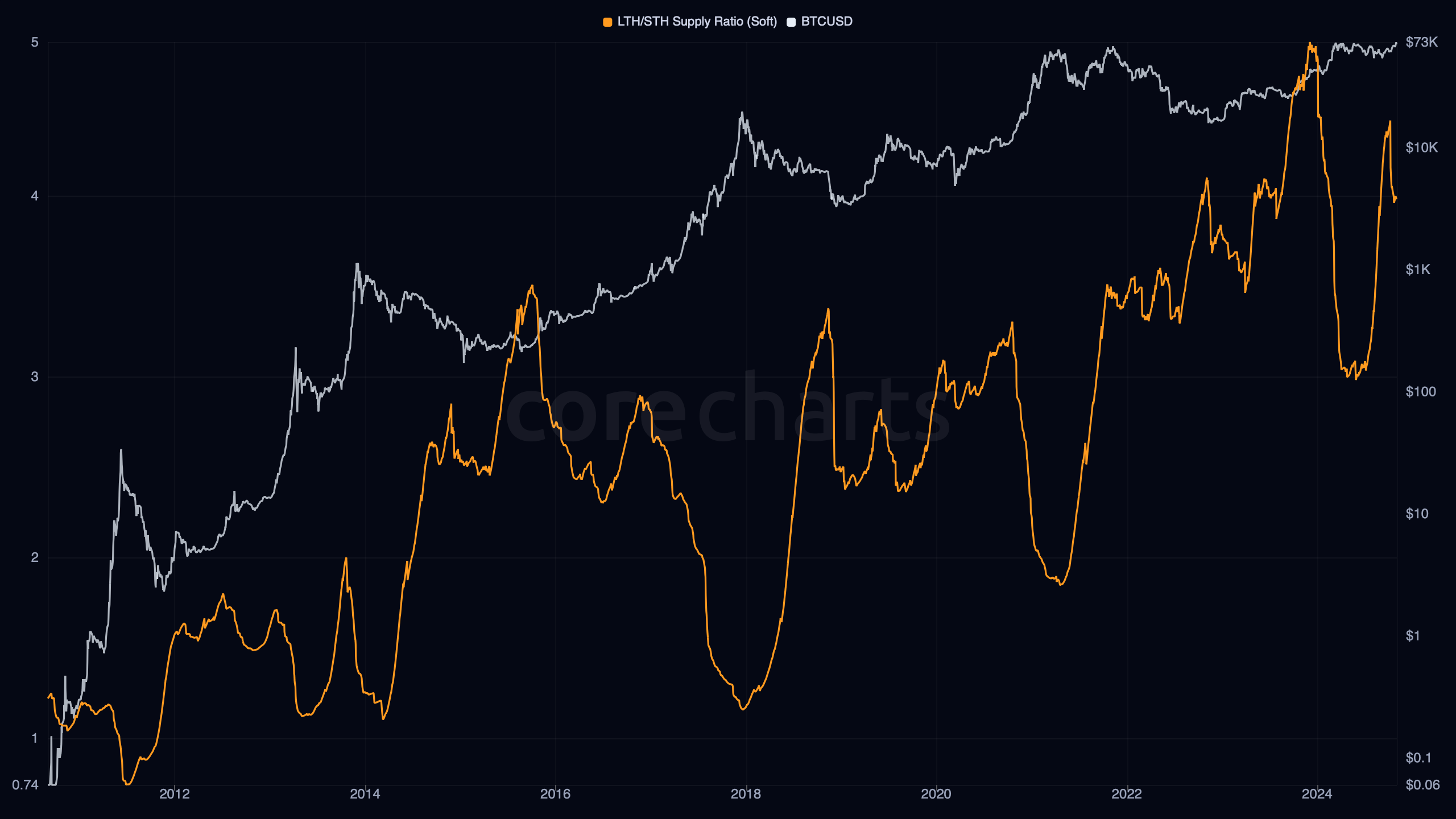
The unit is a ratio. A value of 4.0 means softly weighted LTH supply is four times softly weighted STH supply.
The split uses the standard 155-day STH/LTH maturity area, but the boundary is treated as a gradual transition rather than a hard cutoff. Coins near the boundary receive partial cohort weights, which reduces mechanical jumps when coin age crosses the threshold.
The ratio summarizes which side of the coin-age structure dominates: mature supply or recently moved supply.
Interpretation#
High readings usually belong to accumulation-heavy regimes. Older supply dominates, and recent turnover is relatively low. In that condition, a larger part of the economically counted coin inventory sits on the mature-holder side of the split.
A rising ratio can come from recent supply aging into the LTH cohort, from lower recent movement, or from both. The ratio rises when mature supply gains relative weight against short-term holder supply.
A falling ratio means STH-weighted supply is gaining share. That often appears during distribution, renewed demand, or higher on-chain activity after coins move and reset age.
The direction of the ratio separates supply aging from recent turnover. It does not state whether the coins that moved were spent in profit or loss.
Reading the Series#
During accumulation-heavy periods, the ratio can rise as supply ages and recent movement declines. This condition often leaves LTH supply high relative to STH supply.
During distribution or renewed demand, older coins can move and re-enter the recent-holder side of the split. The ratio can fall even if total supply is unchanged, because coin age has been reset.
A fast decline in the ratio means the short-term holder side has expanded relative to mature supply. That can happen when older coins move into newer hands, when recent buyers absorb supply, or when internal movement resets coin age.
A high ratio does not mean market liquidity is absent. It means mature supply dominates the coin-age accounting, while exchange inventory, custody structure, and derivative liquidity sit outside the ratio.
Relationship to Other Metrics#
STH Supply (Soft) is the denominator of the ratio. It measures the softly weighted recent-holder BTC inventory.
LTH Supply (Soft) is the numerator. It measures the softly weighted mature-holder BTC inventory.
STH/LTH Realized Price adds the cost-basis layer behind the same age cohorts. The supply ratio measures inventory dominance, while realized price measures the average on-chain cost basis carried by each cohort.
LTH/STH Supply Ratio differs from direct supply lines because it compresses the cohort balance into one relative series. The individual supply lines preserve the absolute BTC amounts on each side of the split.
Methodology Note#
The 155-day boundary is based on coin age, not known holder identity. Coins are assigned to cohorts by time since last on-chain movement.
The soft split reduces boundary artifacts around the maturity threshold. A coin does not move from full STH weight to full LTH weight in one step; the transition is smoothed around the 155-day area.
Exchange reshuffling, custody movements, batching, and change outputs can reset coin age without proving a new economic buyer. The ratio inherits this boundary from UTXO-based cohort analysis.
The ratio can move because the numerator changes, the denominator changes, or both. A ratio move should be separated from the absolute BTC scale of STH Supply (Soft) and LTH Supply (Soft).
Historical Background#
The short-term and long-term holder distinction became common in Bitcoin on-chain analysis after empirical work on UTXO spending probability. Coins tend to become less likely to move as they age, with the decline in spending probability flattening around the five-month area.
The 155-day boundary became a practical way to separate recently moved supply from mature supply. Later cohort implementations introduced soft boundaries to reduce mechanical jumps around the cutoff.
The LTH/STH Supply Ratio applies that cohort split as a relative balance between mature and recent supply. It belongs to the same cohort family as STH Supply, LTH Supply, STH Realized Price, and LTH Realized Price.