Bitcoin Supply in Loss#
What It Measures#
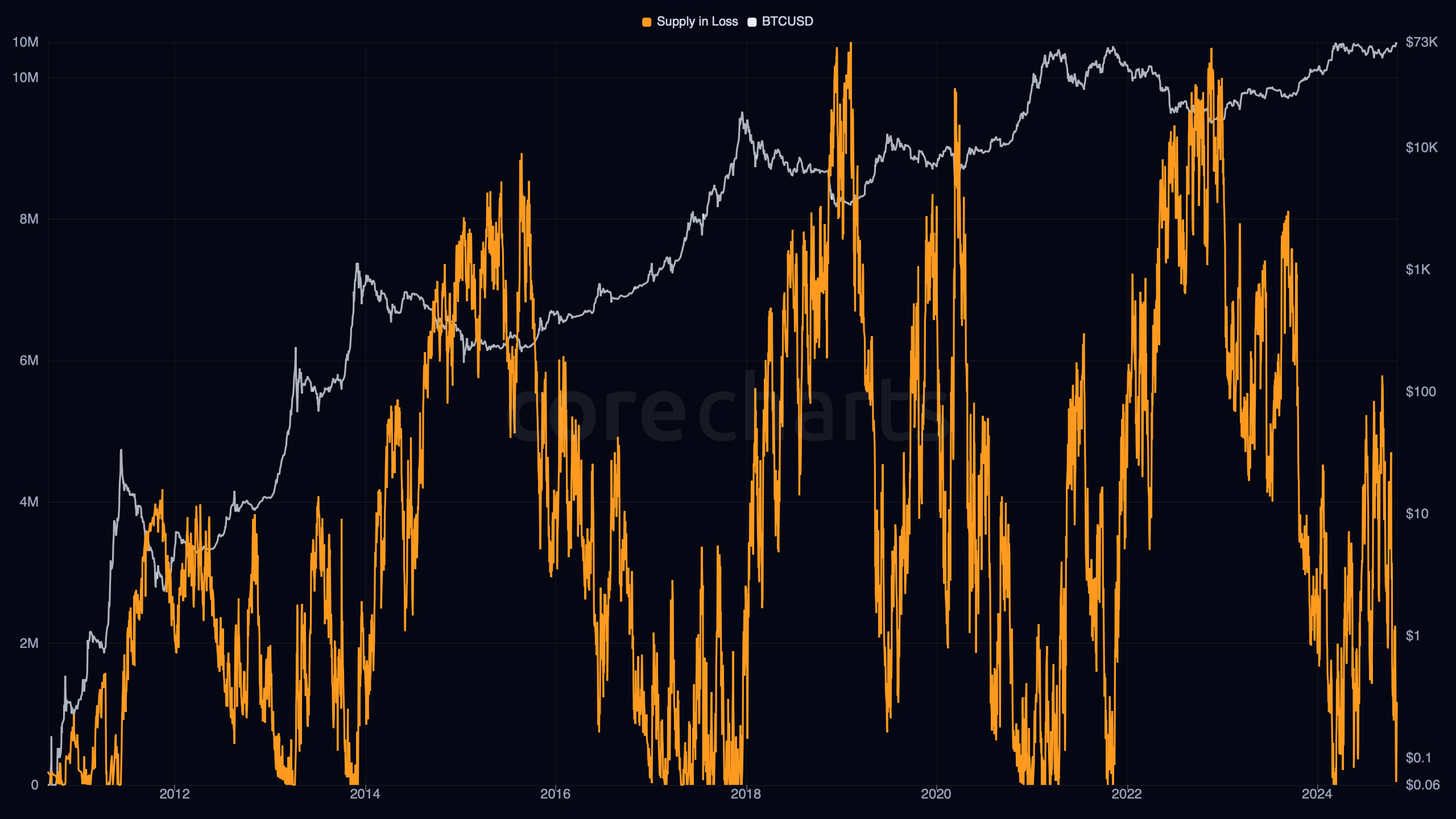
Bitcoin Supply in Loss counts the amount of BTC whose current market price is below the price at which those coins last moved on-chain.
In CoreCharts, coins enter this bucket when current daily BTC price is below their realized cost basis. The output is expressed in BTC.
This is not realized loss and not unrealized loss in USD. It does not say how deep the loss is. It states how much supply sits below cost basis at the current price.
It also differs from Percent Supply in Loss. That normalized version describes share of supply. This one keeps the result in native BTC units.
Interpretation#
A rising reading means more coins are now underwater relative to their last on-chain acquisition price. The usual driver is market price falling through more realized cost-basis bands.
Large values tend to appear in deep corrective or bear-market phases. A bigger part of the outstanding supply then carries negative mark-to-market P/L, even if those coins have not been spent yet.
Falling values mean loss-bearing supply is shrinking. That can happen through recovery in spot price, through coins repricing lower on-chain, or through both at once.
Price And Market Regime#
Underwater Supply Regimes#
High supply in loss marks a market where a large BTC amount is held below cost basis. That is a different condition from a few recent buyers being underwater. It means the loss state has spread across a wider slice of the coin base.
Those regimes often coincide with weak sentiment and poor balance-sheet conditions across holders. The metric stays on supply state, though. It does not say whether that underwater supply is likely to sell.
Recovery Phases#
As price recovers, loss-bearing supply can contract quickly if the market is moving through dense realized-price zones. Coins flip from loss to profit one cost-basis layer at a time.
The move does not need fresh issuance or new supply creation. A change in current price alone can reclassify large BTC amounts between the loss and profit buckets.
Relationship to other metrics#
Supply in Profit is the natural counterpart. The two series describe the same supply from opposite sides of cost basis.
NUPL captures the net valuation gap in ratio form. Supply in Loss says nothing about the dollar depth of those losses. It counts BTC volume sitting below realized price.
Realized Loss belongs to a different layer. Supply in Loss describes coins still held below cost basis. Realized Loss records the USD value of losses locked in when such coins are actually spent.
Methodology Note#
CoreCharts calculates this series from current daily BTC price versus realized cost basis of existing supply. The output is a state variable for outstanding coins.
That makes it different from flow metrics built from spent outputs. Coins can remain in loss for a long time without generating any realized loss on-chain.