Bitcoin Spent Output Age Bands (SOAB)#
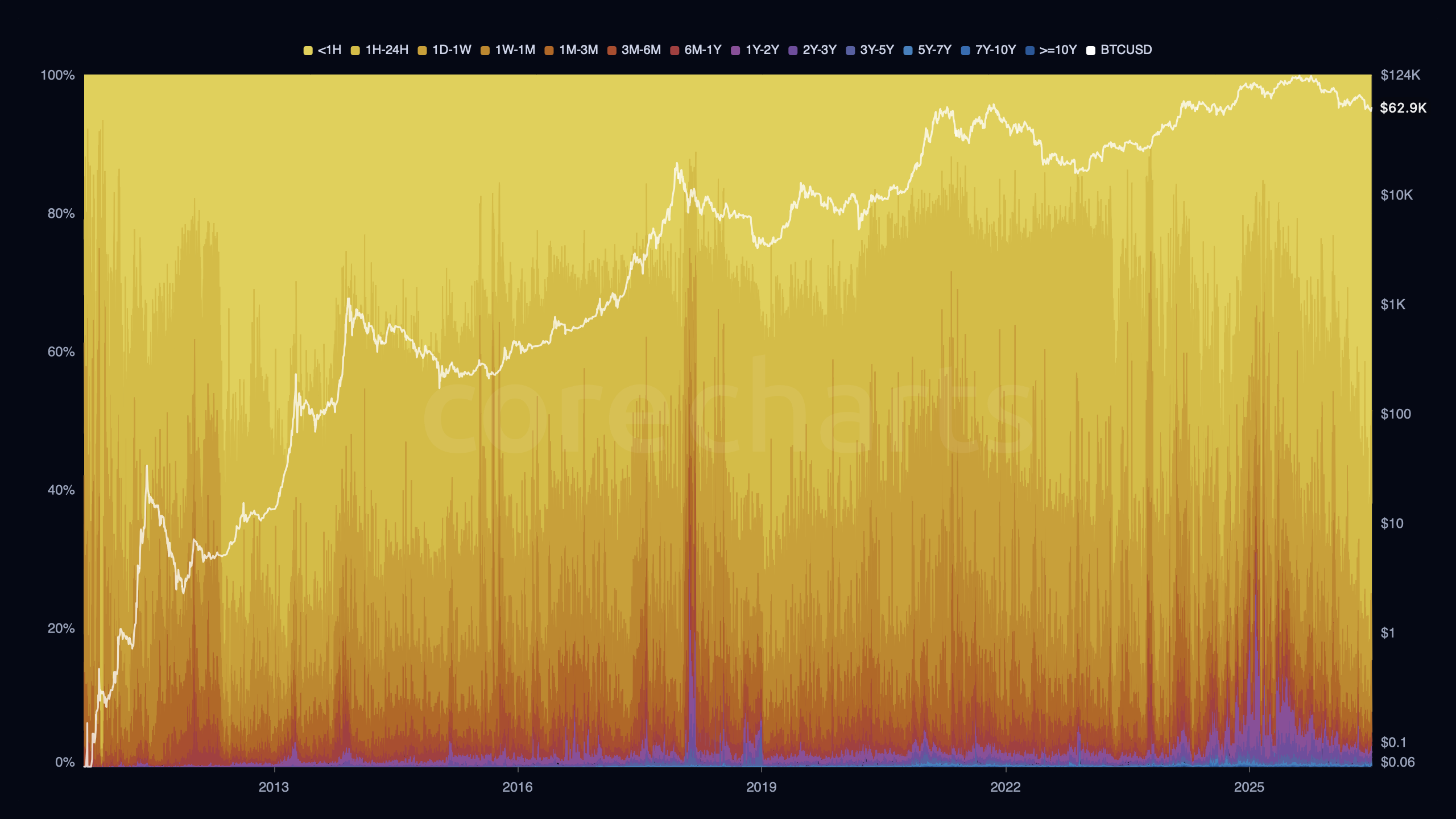
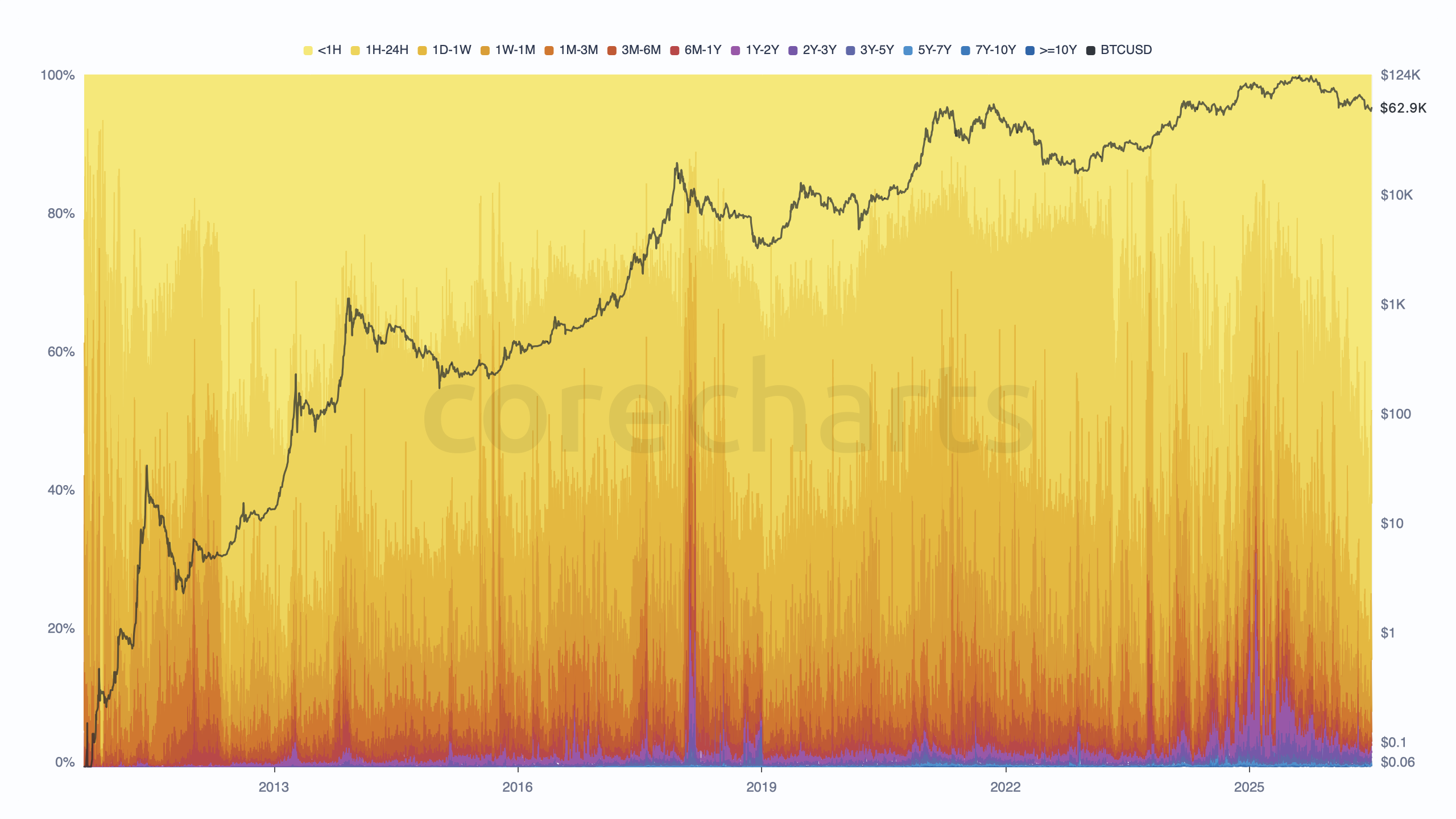
Bitcoin Spent Output Age Bands (SOAB) split daily spent outputs by the age of the coins at the moment they move. In CoreCharts, each band answers one direct question: which coin-age cohorts contributed the most spent outputs today.
This is a spent-side age distribution by output count. It is not a supply-held distribution like HODL Waves, and it is not value-weighted like SVAB. It tracks movement breadth across spent outputs, not the BTC value those outputs carried.
The key reading rule#
SOAB counts each spent output equally. SVAB weights each spent output by BTC value.
That distinction matters. A high SOAB reading with a flat SVAB reading in the same age band often points to transaction structuring, exchange batching, UTXO consolidation, dust movement, or operational wallet activity rather than large economic distribution.
A high SOAB reading confirmed by SVAB carries stronger market information. In that case, many outputs moved and those outputs also carried meaningful BTC value.
Use SOAB to read breadth of movement. Use SVAB to read economic weight.
What the metric measures#
CoreCharts builds these series from the daily spends dataset. For every spent output, the script uses:
- the output counted as one unit, independent of its BTC value,
- the block timestamp when that output was created,
- the block timestamp when that output was spent.
Coin age is measured as:
For bands above one day, age is converted to whole days:
Daily spent outputs are then counted inside each age bucket.
The full CoreCharts band set is:
- lt_1h — spent in less than 1 hour
- 1h_24h — spent between 1 hour and 24 hours
- 1d_1w — spent between 1 day and 1 week
- 1w_1m — spent between 1 week and 1 month
- 1m_3m — spent between 1 month and 3 months
- 3m_6m — spent between 3 months and 6 months
- 6m_1y — spent between 6 months and 1 year
- 1y_2y — spent between 1 year and 2 years
- 2y_3y — spent between 2 years and 3 years
- 3y_5y — spent between 3 years and 5 years
- 5y_7y — spent between 5 years and 7 years
- 7y_10y — spent between 7 years and 10 years
- ge_10y — spent after 10 years or more
Each series is reported as spent outputs per day.
Practical interpretation of the bands#
The short bands — especially lt_1h, 1h_24h, and 1d_1w — react quickly to current transaction flow. They often expand during exchange activity, fast wallet turnover, consolidation, batching, and short-term churn.
The middle bands — roughly 1w_1m through 6m_1y — show outputs that survived beyond immediate turnover but did not remain dormant for a full cycle. These bands can rise when medium-duration UTXOs re-enter circulation or when wallet operators restructure coins after a regime shift.
The older bands — 1y_2y and beyond — matter most when they expand together with value-weighted metrics. A rise in old SOAB bands shows that more old outputs moved. A rise in old SOAB and old SVAB together shows that old outputs moved with meaningful BTC value.
How to use it#
The main use of Spent Output Age Bands is to identify which holding-period cohorts are active by output count.
A simple way to read the structure is:
- rising short SOAB bands with flat SVAB bands — broad short-term movement, often transaction structuring rather than large value transfer;
- rising medium-age SOAB bands — intermediate UTXO cohorts are becoming more active;
- rising old SOAB bands with SVAB confirmation — older supply is moving by both count and value;
- rising old SOAB bands without SVAB confirmation — many older outputs moved, but the BTC value may be limited.
That distinction matters because equal output activity can mean very different things. A day dominated by lt_1h and 1h_24h can reflect wallet churn. A day dominated by 3y_5y or ge_10y can show older cohorts returning to activity. SVAB tells you whether that activity also carried economic weight.
This metric is especially useful next to:
- SVAB,
- price,
- SOPR,
- ASOL / MSOL,
- revived supply thresholds,
- HODL Waves.
HODL Waves tell you where supply still sits. SOAB tells you which part of that supply started moving by output count.
Reading market behavior with it#
Spent output age bands are not a standalone timing tool. They work best as a confirmation and classification tool for on-chain movement.
Short-term churn and transaction structuring#
During active markets, short SOAB bands often expand before the move carries much economic meaning. Exchanges can batch withdrawals, wallets can consolidate UTXOs, and users can reshuffle recently created outputs without moving large BTC value.
This is where SOAB differs most from SVAB. SOAB can show a large count of outputs moving even when spent volume remains modest. That pattern usually says more about transaction structure than holder distribution.
Older-output participation#
When older SOAB bands rise — especially 1y_2y, 2y_3y, 3y_5y, and older — older cohorts are participating by count.
Read that move in two steps. First, SOAB tells you whether old outputs appeared in the spent set. Then SVAB tells you whether those old outputs mattered in BTC terms. A count-only rise can come from many small dormant outputs. A count-and-value rise carries stronger evidence of meaningful old-supply movement.
Stress, consolidation, and wallet operations#
SOAB can move sharply during stress events, consolidation waves, and operational wallet changes. Because it counts outputs rather than value, it often exposes activity that value-weighted metrics compress.
If young SOAB bands expand during a drawdown, recent outputs are turning over quickly. If old SOAB bands expand at the same time, older cohorts are also participating by count. If SVAB stays flat, the event may involve many outputs but limited BTC value.
What analytical question it answers#
SOAB answers the count-side version of spent-age analysis:
Which age cohort supplied the most spent outputs?
SVAB answers the value-side version. It shows which age cohort supplied the most BTC value.
Together, the two views separate breadth of movement from economic weight.
Relationship to other age-based metrics#
Spent Output Age Bands are closely related to several other Bitcoin age metrics, but they are not interchangeable.
- Spent Volume Age Bands show the same spent-age structure weighted by BTC value.
- HODL Waves describe the current age structure of unspent supply.
- Revived Supply collapses old-coin spending into threshold-based groups such as 1y+, 2y+, 5y+, or 10y+.
- ASOL and MSOL summarize average and median age of spent outputs.
- CDD weights coin age by value and compresses spending activity into a single aggregate.
SOAB sits closest to SVAB, but it changes the weighting scheme. SVAB weights each band by BTC value. SOAB counts each spent output equally, regardless of its BTC value.
Historical background#
Spent-output age analysis comes from the same UTXO research tradition as coin days destroyed, dormancy, spent output lifespan, and revived supply. Analysts have long separated young coins from old coins because a transfer from a coin last moved yesterday carries different behavioral information than a transfer from a coin last moved five years ago.
SOAB adds a count-weighted view to that tradition. It does not ask how much value old coins carried. It asks how many old outputs entered the spent set. That makes it especially useful when transaction structure itself matters: batching, consolidation, dust movement, and wallet operations can all change the output-count footprint without matching value-weighted intensity.
CoreCharts separates SOAB from SVAB so analysts can see whether old-coin movement is large in BTC terms, broad in output-count terms, or both.
Notes on interpretation#
A rise in an older SOAB band does not automatically mean large holders distributed meaningful BTC value. It means more outputs with that age profile were spent on that day.
The economic interpretation depends on context:
- trend direction,
- price location in the cycle,
- whether SVAB confirms the move by BTC value,
- whether spending is broad or concentrated,
- whether the move lines up with SOPR, dormancy, or revived supply.
SOAB is best read as a breadth metric for spent-age activity. It helps separate many outputs moving from large value moving, which makes it a useful companion to SVAB rather than a replacement for it.