Bitcoin Supply in Profit and Loss#
Definition#
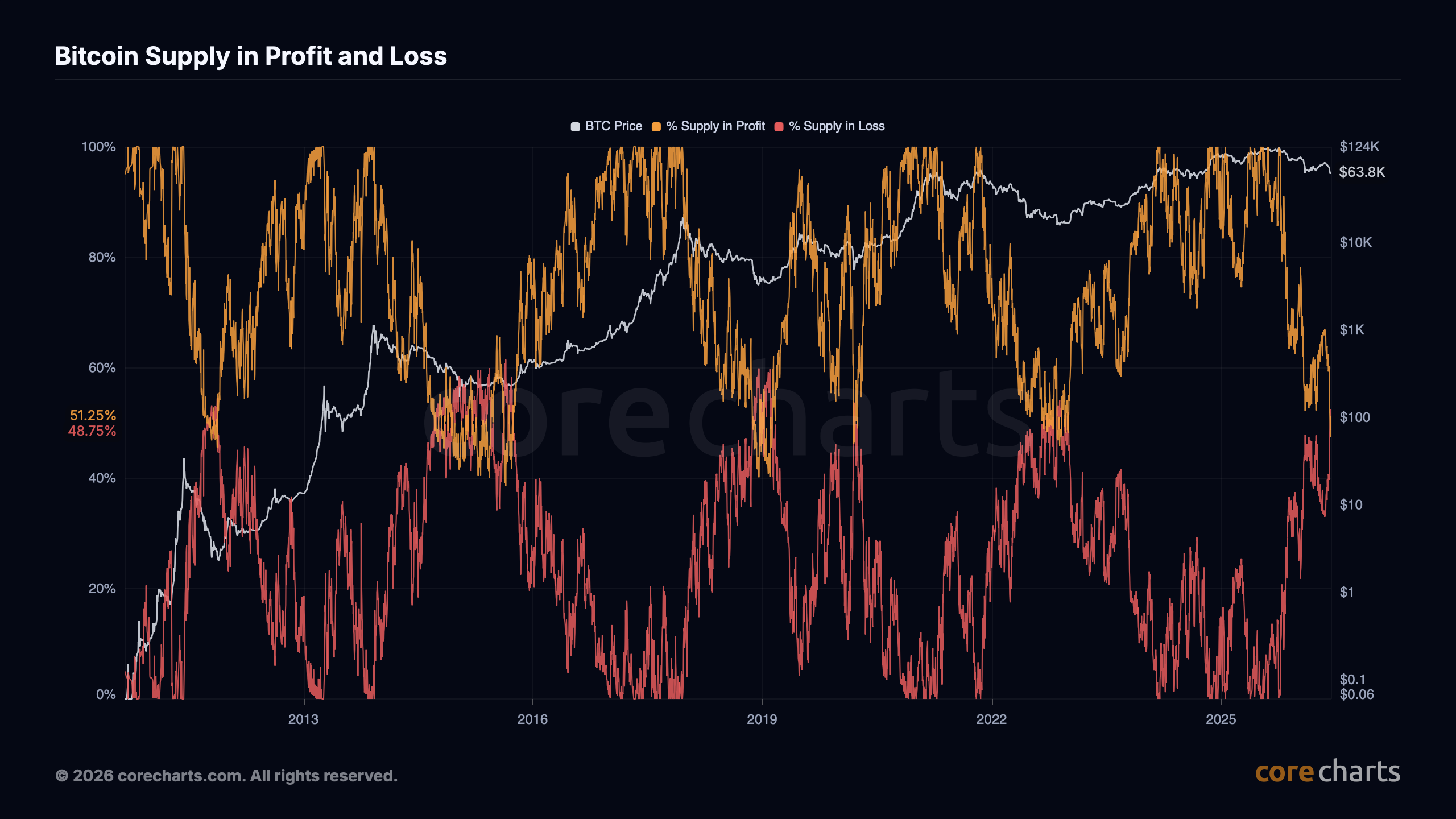
Bitcoin Supply in Profit and Loss splits circulating supply into two cost-basis states. Supply in profit is the share of BTC whose current BTC price is above the price at which those coins last moved on-chain. Supply in loss is the share whose current BTC price is below that last-moved price.
The unit is percent of circulating BTC supply. The two series are complementary state buckets: when the profit share rises, the loss share falls by the same amount, apart from small differences caused by data coverage, rounding, or implementation boundaries.
The metric works at the supply-state level. It does not measure realized gains, realized losses, or the size of each coin’s profit or loss. A coin can be far above its cost basis or only slightly above it; both are counted inside supply in profit. Realized Profit, Realized Loss, and SOPR belong to the flow side because they require spending.
Interpretation#
A rising profit share means more BTC supply is priced above its realized cost basis. This usually occurs after price moves through dense cost-basis clusters, converting previously underwater coins into profitable coins. A rising loss share means spot price has moved below a larger part of the realized cost-basis distribution.
High profit-share readings usually belong to strong markup phases or late-cycle periods where most coins sit above their acquisition price. The condition can coexist with elevated unrealized gains and higher incentive to distribute, but the series does not identify which holders are likely to spend.
High loss-share readings occur when price trades below a large share of aggregate cost basis. Deep bear markets, post-capitulation periods, and prolonged underwater regimes usually leave a visible loss-side footprint. The level alone does not separate forced selling from passive holding.
NUPL compresses unrealized profit and loss into a net ratio, while this metric keeps the two sides visible. MVRV Ratio compares market value with realized value at the aggregate level. Supply in Profit BTC and Supply in Loss BTC retain the raw BTC amounts before conversion into shares of circulating supply.
Reading the Series#
Near cycle highs, supply in profit often approaches the upper end of its historical range. Price has moved above most realized cost-basis clusters, and the remaining loss-side supply is usually small. High profit-share readings can persist for long periods during bull markets because profitable supply does not automatically become spent supply.
During sharp drawdowns, the loss share can rise quickly as spot price crosses recent acquisition zones. The move is often fastest when price cuts through cost-basis clusters formed during the previous advance. A large shift from profit to loss marks a broad repricing of holder balance sheets.
During basing periods, both series can stabilize while price trades around large cost-basis zones. Small price moves near those zones can move supply between profit and loss without a large change in market structure. STH MVRV often adds cohort detail because recently moved coins are more sensitive to current price than older coins.
A recovery from a high-loss regime converts underwater supply back into profitable supply. The path matters: a fast recovery usually moves the split sharply, while a slow recovery can leave profit and loss shares near balance for months. Realized Cap changes only when coins move, so it does not reprice the entire supply with every spot move.
Relationship to Other Metrics#
NUPL subtracts unrealized losses from unrealized profits and scales the result by market value. Supply in Profit and Loss keeps the count-based split visible, so two dates with similar NUPL can still have different supply distributions.
MVRV Ratio compares market capitalization with realized capitalization. It is sensitive to aggregate valuation against cost basis, while Supply in Profit and Loss counts how much supply sits on either side of that cost basis.
SOPR measures realized profit or loss on spent outputs. Supply in Profit and Loss includes coins whether or not they move. A high profit share with weak SOPR means profitable coins exist, but spent coins are not realizing large gains.
Supply in Profit BTC and Supply in Loss BTC are the raw input series. The percentage version removes the effect of changing circulating supply and makes long-history comparisons cleaner.
Methodology Note#
Each coin’s cost basis is assigned from the market price at the time it last moved on-chain. If the current BTC price is above that cost basis, the coin belongs to supply in profit. If the current BTC price is below it, the coin belongs to supply in loss.
On-chain movement does not equal ownership transfer. Exchange consolidation, internal wallet operations, batching, and change outputs can update a coin’s last-moved price without representing a new economic buyer. The metric inherits that boundary from UTXO-based cost-basis analysis.
Lost coins remain part of the state calculation if they are still in the UTXO set. Their last-moved price can sit far below current market price for many years, which keeps them inside supply in profit during most modern market regimes.
Historical Background#
Supply in Profit and Supply in Loss grew out of realized-price and realized-cap accounting in Bitcoin on-chain analysis. Once each UTXO could be assigned a last-moved market price, analysts could classify supply by whether current price sat above or below that cost basis.
The concept became common across Bitcoin analytics platforms as a direct supply-split formulation of the realized-cap idea.
Supply in Profit and Supply in Loss are not usually attributed to a single author. The metric belongs to the family of UTXO cost-basis measures that developed after realized capitalization became a standard Bitcoin on-chain concept.