Bitcoin Supply in Profit and Loss (BTC)#
Definition#
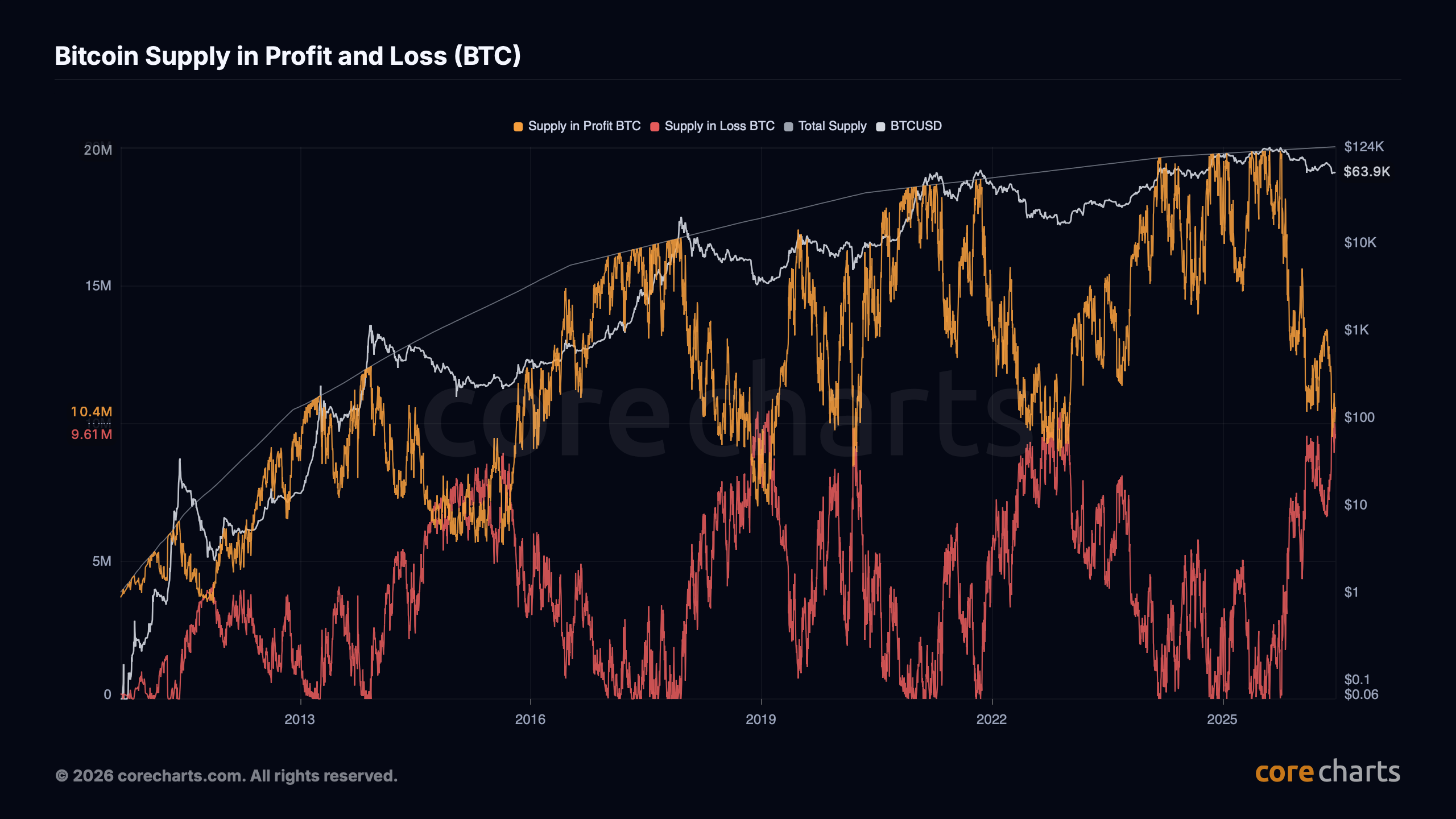
Bitcoin Supply in Profit and Loss (BTC) measures the BTC amount currently above or below realized cost basis. Supply in Profit BTC is the amount of economically counted BTC whose current price is above the market price assigned when those coins last moved on-chain. Supply in Loss BTC is the amount whose current price is below that assigned price.
Here is the BTC value of unit , is current BTC price, and is the market price assigned when that unit last moved on-chain.
The unit is BTC. The chart also includes Total Economic Supply, which defines the supply base used by this BTC-denominated version.
The approximation allows for rounding, boundary cases, and any exclusions applied by the economic-supply model.
This version measures inventory size, not supply share. Supply in Profit and Loss (%) classifies the same states in percentage terms, while the BTC version preserves the absolute amount of profitable and underwater supply.
It does not identify ownership transfer with certainty. Cost basis is reassigned on on-chain movement, and on-chain movement can include exchange reshuffling, internal wallet activity, batching, and change outputs.
Interpretation#
Supply in Profit BTC rises when spot moves above more realized-cost clusters. More BTC then sits above its assigned cost basis.
Supply in Loss BTC rises when spot moves below more realized-cost clusters. Recent acquisition zones usually move underwater first. Deeper drawdowns can pull older and lower-cost supply into loss as price cuts through broader parts of the realized-price distribution.
The BTC denomination matters when the size of profitable or underwater inventory is part of the question. Ten million BTC in profit and ten million BTC in loss describe inventory states directly. A percentage series normalizes those states against a supply base and removes part of that scale.
Total Economic Supply anchors the split. A larger BTC amount in loss does not automatically mean a larger share of supply is underwater, because the supply base can change underneath the same classification.
Supply in Profit and Loss (%) is better for composition across long history. The BTC version is better when the absolute inventory on each side of cost basis is the analytical object.
Reading the Series#
During strong advances, most economically counted BTC can remain in profit for extended periods. The percentage version can flatten near its upper bound in those conditions, while the BTC version still shows whether profitable inventory is continuing to grow in absolute terms.
Broad drawdowns usually push Supply in Loss BTC higher as spot falls through dense cost-basis zones. The BTC amount shows how much inventory is underwater. The percentage version shows how much of the supply base is underwater. Those are related, but they are not the same statement.
The distance between Supply in Profit BTC and Supply in Loss BTC is often the most important part of the chart. When the two lines are far apart, one state dominates the supply base. When they converge, profitable and underwater inventory are close to balance.
Deep bear markets usually compress this gap as price falls below large parts of the realized-cost distribution. A near-equal split means the market has repriced enough supply that profit and loss are no longer one-sided. Historically, this balance has tended to appear during major stress and bottoming regimes, but it describes market state, not timing.
A widening gap after convergence usually means price has moved back above enough cost-basis clusters to return a larger share of supply to profit. The BTC-denominated view shows how much inventory participates in that transition, while the percentage version shows the breadth of the shift.
A large Supply in Loss BTC reading means a large BTC inventory sits below assigned cost basis on an unrealized basis. Realized Loss measures the subset that actually moved and locked in loss.
A large Supply in Profit BTC reading means a large BTC inventory sits above assigned cost basis on an unrealized basis. Realized Profit measures the subset that moved and crystallized gains through spending.
This is a stock measure. SOPR, Realized Profit, and Realized Loss are flow measures because they depend on spent output activity.
Relationship to Other Metrics#
Supply in Profit and Loss (%) applies the same profit-loss classification in share terms. The percentage view tracks composition across changing supply levels. The BTC view keeps inventory scale visible.
NUPL and MVRV compress the market’s relationship to realized value into aggregate valuation measures. NUPL nets unrealized profit and loss into one ratio. MVRV compares market cap with realized cap. Supply in Profit and Loss (BTC) keeps the gross split visible before those states are collapsed into a single aggregate relationship.
Realized Profit, Realized Loss, and SOPR require coins to move. Supply in Profit and Loss (BTC) does not. It measures the inventory currently above or below cost basis before any gain or loss is realized on-chain.
Realized Price is an aggregate cost-basis line for the supply as a whole. Supply in Profit and Loss (BTC) classifies inventory around individual realized prices, so substantial BTC can remain in profit or loss even when spot trades close to aggregate Realized Price.
Methodology Note#
CoreCharts anchors this BTC-denominated split to Total Economic Supply. The percentage version is expressed against a different supply base, so the two views should not be treated as a direct BTC-to-percent conversion.
Each unit’s cost basis is assigned from the market price when it last moved on-chain. If current BTC price is above that assigned level, the unit belongs to Supply in Profit BTC. If current BTC price is below it, the unit belongs to Supply in Loss BTC.
Lost coins remain in the UTXO set unless excluded by a separate supply model. Their assigned prices often sit far below current market levels, which leaves much long-dormant supply in profit across most recent market regimes.
Units exactly at realized cost basis sit on the boundary between profit and loss. Exact equality is rare in daily data and has little effect on the aggregate BTC split.
Historical Background#
Supply in Profit and Supply in Loss emerged from realized-cap and realized-price style accounting in Bitcoin on-chain analysis. Once each unit of supply could be assigned a last-moved market price, the supply could be classified by whether spot traded above or below that assigned basis.
The percentage form became common across Bitcoin analytics because it normalizes the split across a changing supply base. The BTC-denominated form remained useful where inventory size itself mattered, especially in studies of underwater supply and unrealized gain concentration.
The metric belongs to the same UTXO cost-basis family as realized capitalization, realized price, NUPL, and MVRV.