Bitcoin Realized Cap vs Market Cap#
Definition#
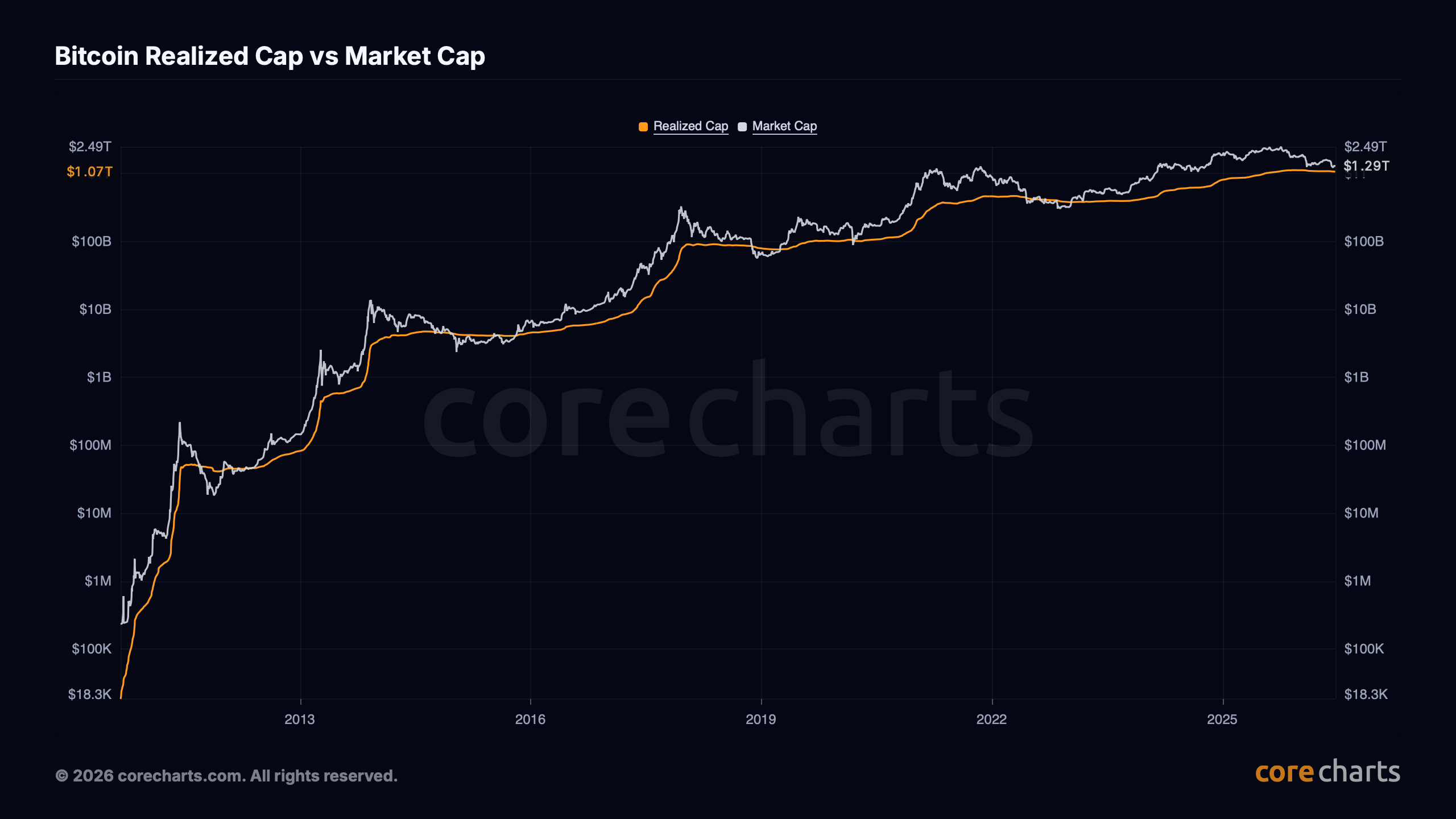
Bitcoin Realized Cap vs Market Cap compares two USD valuation bases for the same monetary network.
Market Cap marks circulating supply at the current BTC price:
Realized Cap values each coin at the price when it last moved on-chain:
Both series are expressed in USD. Market Cap reprices immediately with spot price. Realized Cap changes when coins move and reset their on-chain cost basis. Coins that have not moved for years continue to carry the price from their last on-chain transfer.
The difference between the two lines is the absolute USD spread between market valuation and aggregate realized cost basis:
A positive spread means the market values circulating supply above aggregate realized cost basis. A negative spread means the market values circulating supply below aggregate realized cost basis.
Interpretation#
Market Cap moves with price across the full circulating supply. Realized Cap moves through coin transfer: old coins repriced at higher market prices raise the realized base, while coins moving below prior cost basis can lower it.
A rising Market Cap with a slower Realized Cap means spot valuation is moving further above aggregate cost basis. A rising Realized Cap means coins are changing hands at higher prices than their previous on-chain cost basis, adding new realized value to the network.
A falling Market Cap with a stable Realized Cap means spot valuation is falling while the realized base remains largely unchanged. A falling Realized Cap requires coins to move at lower prices than their previous cost basis, so it usually appears during periods when loss realization reaches older cost-basis clusters.
MVRV converts the same relationship into a ratio. NUPL expresses the market-minus-realized spread relative to Market Cap. MVRV Delta keeps the spread in absolute USD terms as its own series. Realized Price divides Realized Cap by circulating supply and places the aggregate cost basis on a per-BTC price scale.
Market Regime Reading#
Wide separation between Market Cap and Realized Cap means a large amount of unrealized profit exists across the coin supply. The USD distance matters when the absolute size of the market-cost-basis gap is analytically relevant, especially when comparing the scale of current unrealized gains or losses with prior periods in dollar terms.
Market Cap can fall quickly while Realized Cap remains elevated. In that condition, spot price has repriced the network lower, but the aggregate cost-basis base has not yet reset. Realized Cap declines only when coins move at lower prices than their previous on-chain acquisition level.
After major drawdowns, a rising Realized Cap can come from new capital entering the realized base, distribution from older low-cost coins to newer higher-cost holders, or both. Cohort-level realized cap, realized profit and loss, and spent-output age data separate those mechanisms.
When Market Cap and Realized Cap converge, the market price is approaching aggregate realized cost basis. Negative spreads are rare at full-market scale and require spot valuation to fall below the realized value stored across the coin supply.
Relationship to Other Metrics#
MVRV removes the USD scale and turns the Market Cap versus Realized Cap relation into a multiple:
A reading of 2.0 means Market Cap is twice Realized Cap. The ratio is cleaner for cycle comparison than the raw USD spread because Bitcoin’s monetary base and price level changed substantially across cycles.
NUPL measures the same market-minus-realized structure as a share of Market Cap:
MVRV Z-Score standardizes the Market Cap minus Realized Cap spread by market-cap volatility. The classic version standardizes the capitalization spread, not the MVRV ratio itself.
Realized Price moves from aggregate capitalization to per-BTC cost basis:
Realized Profit and Realized Loss measure the profit or loss locked in when coins move. Realized Cap is the stock of realized value still embedded in the UTXO set; realized profit and loss are flows generated by spending.
Methodology Note#
Realized Cap depends on the price assigned to each coin at its last on-chain movement. For UTXO-based accounting, that means each unspent output carries the market price from the day it was created or last transferred.
Lost coins are not removed by direct identification. Their influence is reduced because long-dormant coins keep older cost-basis values instead of being marked to the current spot price. This treatment is one reason Realized Cap can sit far below Market Cap during high-price regimes.
Market Cap and Realized Cap are both USD-denominated valuation series, but their repricing mechanisms are different. Market Cap reprices every coin at the current market price. Realized Cap reprices only the coins that move.
Historical Background#
Realized capitalization entered Bitcoin on-chain analysis in 2018 as an alternative to marking every coin at the current market price. The concept was introduced by Nic Carter and Antoine Le Calvez at Coin Metrics.
The original motivation was Bitcoin’s large dormant supply. Market Cap treats unmoved early coins as if they are liquid at the current price. Realized Cap keeps those coins valued at their last on-chain transfer price, reducing the effect of old inactive supply on the aggregate valuation base.
MVRV followed as a natural ratio between Market Cap and Realized Cap. David Puell and Murad Mahmudov introduced the MVRV ratio in 2018, building on the Realized Cap concept. The ratio made the capitalization comparison easier to compare across Bitcoin’s price history, while the raw Realized Cap versus Market Cap chart preserved the absolute USD scale of the valuation spread.